Overview: The Ace Up Your Sleeve
Welcome, players from Kuala Lumpur to Kota Kinabalu! If you've ever sat at a Blackjack table, whether at Genting Highlands or on your favourite online casino, you've encountered the game's most flexible and powerful card: the Ace. When an Ace is in your hand and counted as 11, you're holding what's known as a 'soft hand'. For many casual players, these hands are a source of confusion. Do you hit? Do you stand? Do you double down? This uncertainty is where the house gains its edge. But for the skilled player, a soft hand is not a problem; it's an opportunity. This guide is designed to transform you into that skilled player. We will dissect every possible soft hand, providing you with a clear, authoritative strategy rooted in mathematical probability. By mastering the art of playing soft hands, you will significantly reduce the house edge and increase your confidence and profitability at the tables. This isn't about guesswork or 'feeling lucky'; it's about applying a proven system that separates the pros from the amateurs. Understanding soft hands is a critical step in moving beyond simply playing Blackjack to strategically winning it. Let's turn that flexible Ace into your most formidable weapon.
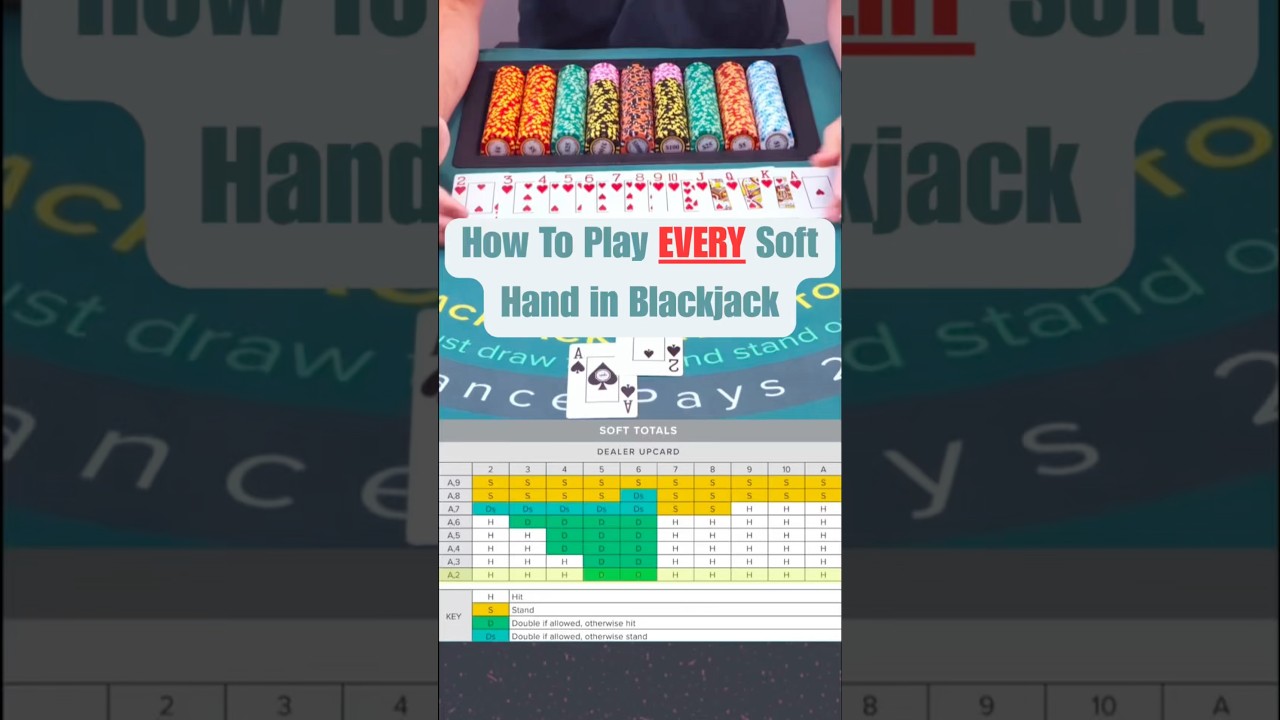
This guide will focus on the most common Blackjack rules found in Malaysia and online, typically using 6-8 decks where the dealer stands on all 17s (S17). If the rules differ, such as the dealer hitting on a soft 17 (H17), slight adjustments are needed, which we will also address. Prepare to elevate your game from a pastime to a calculated discipline.
The Golden Rule of Soft Hands
Before diving into complex charts, you must internalize one simple, powerful concept: The Golden Rule of Soft Hands. It is this: A soft hand cannot bust when you take one more card. This is the fundamental truth that governs all soft hand strategy. Why? Because the Ace in your hand has a dual identity. It can be a 1 or an 11. If you have a Soft 17 (an Ace and a 6), its value is 17. If you hit and receive a 5, your hand doesn't become 22 and bust. Instead, the Ace's value automatically reverts from 11 to 1, making your new total 1 + 6 + 5 = 12. You're still in the game. This safety net is what makes soft hands so strategically different from their 'hard hand' counterparts (hands without an Ace, or where the Ace must be counted as 1).
Understanding the Strategic Implications
This inability to bust on the next hit opens up aggressive plays that would be reckless with a hard hand. Let's compare:
- Hard 17 (e.g., 10 and 7): You must stand. Hitting is statistical suicide, with a high probability of busting. You have no flexibility.
- Soft 17 (e.g., Ace and 6): You have options! Standing is often a poor choice, as 17 is a weak total that often loses or pushes. Hitting is a safe way to try and improve to 18, 19, 20, or 21 without any risk of immediate elimination. Doubling down becomes a powerful tool when the dealer is weak.
This is the core of the strategy. With a hard hand, you are often playing defensively, trying not to bust. With a soft hand, you are playing offensively, trying to maximize your total and exploit the dealer's weaknesses. Many amateur players in Malaysia and beyond make the critical error of treating a soft hand like a hard hand. They stand on Soft 17 or Soft 18 out of fear, when basic strategy demands a more aggressive action. They are essentially giving up the unique advantage the Ace provides. To master Blackjack, you must unlearn this fear and embrace the flexibility of your soft hands. Every decision you make with a soft hand should be based on this principle: you have a free, no-risk opportunity to improve your hand or double your bet against a vulnerable dealer. Don't waste it.
Complete Soft Hand Strategy Guide
This is the heart of our guide. Here, we will break down the mathematically correct play for every soft hand you can be dealt. The strategies below are optimized for the most common multi-deck games where the dealer stands on all 17s (S17). We'll also note key differences for H17 games (Dealer Hits Soft 17), which are less favourable to the player but still found in some online casinos.
Remember these abbreviations:
- H: Hit
- S: Stand
- D: Double Down. If you cannot double, follow the secondary action (usually Hit or Stand).
Soft 13 (Ace, 2) and Soft 14 (Ace, 3)
These are weak starting hands, but their potential for improvement is high.
- Your Action vs. Dealer 2, 3, 4, 7, 8, 9, 10, Ace: HIT (H). You are a significant underdog. Your only goal is to improve your hand without busting.
- Your Action vs. Dealer 5, 6: DOUBLE DOWN (D). This is your power move. The dealer's 5 and 6 are prime bust cards. You are making a calculated wager that the dealer will go over 21. By doubling, you maximize your profit from their weakness. If doubling isn't allowed after being dealt the hand, you should Hit.
Soft 15 (Ace, 4) and Soft 16 (Ace, 5)
Slightly better than the previous hands, the strategy becomes a little more aggressive.
- Your Action vs. Dealer 2, 3, 7, 8, 9, 10, Ace: HIT (H). You need to improve. Standing on 15 or 16 is a losing play in the long run.
- Your Action vs. Dealer 4, 5, 6: DOUBLE DOWN (D). Again, you are attacking the dealer's weakest upcards. The chance of the dealer busting is high, so you want to have the maximum bet on the table. If you can't double, just Hit.
Soft 17 (Ace, 6)
This is one of the most misplayed hands in Blackjack. Many players see '17' and instinctively stand. This is almost always a mistake.
- Your Action vs. Dealer 2, 7, 8, 9, 10, Ace: HIT (H). A total of 17 is a pushing hand at best and a losing hand at worst against these strong dealer cards. You cannot bust, so you must hit to improve your position. You're aiming for 18-21.
- Your Action vs. Dealer 3, 4, 5, 6: DOUBLE DOWN (D). This is a premium doubling opportunity. The dealer is vulnerable, and you have a chance to improve to a strong total or win double if they bust. This is a play that separates winning players from the rest. If you can't double, just Hit. Never Stand on Soft 17 unless the dealer's upcard is not in the double down range and doubling is not an option for some reason.
Soft 18 (Ace, 7)
This is a good hand, but it's not invincible. Your play depends heavily on the dealer's show of strength.
- Your Action vs. Dealer 2, 7, 8: STAND (S). Your 18 is a solid, winning total against these neutral or weaker dealer cards. There's no need to risk making it worse.
- Your Action vs. Dealer 3, 4, 5, 6: DOUBLE DOWN (D). This is a value double. You already have a strong hand (18), and the dealer is showing a bust card. You are doubling down not just hoping the dealer busts, but also because if you get a small card (Ace, 2, 3) you'll have a very strong 19, 20, or 21. If you can't double, Stand.
- Your Action vs. Dealer 9, 10, Ace: HIT (H). This is the move that scares amateurs but makes pros money. Your 18 is an underdog against a dealer's 9, 10, or Ace. You are likely to lose if you stand. Since you can't bust, you take the 'free' card to try and improve to a 19, 20, 21, or get a small card that gives you another chance. Standing here is a slow way to lose your money.
Soft 19 (Ace, 8)
A very strong hand. The strategy is simple.
- Your Action vs. Dealer 2, 3, 4, 5, 7, 8, 9, 10, Ace: STAND (S). You have a total of 19. This is a winning hand in most situations. Don't mess with it.
- Your Action vs. Dealer 6: DOUBLE DOWN (D). This might seem overly aggressive, but the math supports it. The dealer's 6 is so weak that it's profitable in the long run to double your bet here, even with a great hand like 19. You're maximizing your winnings in a highly advantageous situation. If you are not allowed to double, you should Stand.
Soft 20 (Ace, 9) and Soft 21 (Blackjack)
The easiest hands to play.
- Soft 20 (Ace, 9): ALWAYS STAND (S). You have the second-best hand possible. Never risk it.
- Soft 21 (Ace, 10/J/Q/K): This is Blackjack. You get paid instantly (usually 3:2 or 6:5), unless the dealer also has Blackjack, in which case it's a push. Do nothing and enjoy your win.
Important Note: Dealer Hits Soft 17 (H17) Rule
If you are playing in a game where the dealer hits on a soft 17, the dealer is slightly more likely to get a higher total, and the house edge increases. This requires three strategic adjustments for your soft hands:
- Soft 18 (A,7) vs. Dealer 2: You should now HIT instead of Standing.
- Soft 19 (A,8) vs. Dealer 6: You should now STAND instead of Doubling Down.
- Soft 17 (A,6) vs. Dealer 2: You should now DOUBLE DOWN if allowed, otherwise Hit.
Always check the felt of the table; the rules 'Dealer must stand on all 17s' or 'Dealer hits soft 17' will be printed there. The S17 rule is more common and better for you as a player.
Odds, Probabilities & Statistics
Understanding the numbers behind the strategy is crucial for building confidence in your decisions. Playing soft hands correctly isn't based on a hunch; it's based on the Expected Value (EV) of each action. EV tells you the average amount you can expect to win or lose on a bet in the long run. A positive EV play makes you money over time, while a negative EV play costs you money. The entire soft hand basic strategy is designed to always choose the action with the highest possible EV.
Let's look at the math behind one of the most critical decisions: what to do with a Soft 18 (Ace, 7) against a dealer's 9. Many players stand, fearing a hit. The statistics tell a different story.
- EV of Standing: If you stand on Soft 18 against a 9, your expected loss is about -0.08. This means for every RM100 you bet in this situation and stand, you will lose an average of RM8 over the long term.
- EV of Hitting: If you hit on Soft 18 against a 9, your expected loss is only about -0.01. This means for every RM100 you bet, you only lose an average of RM1.
By hitting, you are saving RM7 for every RM100 wagered in this exact scenario. It may not seem like much, but over thousands of hands, these small, correct decisions are what separate a winning player from a losing one. The table below illustrates the player's advantage (or disadvantage) for different actions on key soft hands, demonstrating why basic strategy is optimal. The values represent the percentage gain/loss on your original wager.
| Player Hand | Dealer Upcard | Action: STAND | Action: HIT | Action: DOUBLE | Correct Action |
|---|---|---|---|---|---|
| Soft 17 (A,6) | 3 | -13.9% | -3.8% | +2.9% | Double |
| Soft 17 (A,6) | 7 | -34.6% | -14.1% | N/A | Hit |
| Soft 18 (A,7) | 6 | +30.5% | +10.1% | +37.2% | Double |
| Soft 18 (A,7) | 8 | +11.8% | -7.2% | N/A | Stand |
| Soft 18 (A,7) | 9 | -8.1% | -1.2% | N/A | Hit |
| Soft 19 (A,8) | 6 | +52.9% | +31.5% | +54.3% | Double |
| Soft 14 (A,3) | 5 | -18.7% | -8.4% | +0.5% | Double |
| Soft 14 (A,3) | 7 | -40.1% | -20.0% | N/A | Hit |
As the table clearly shows, the 'Correct Action' consistently provides the highest mathematical return. For instance, standing on Soft 17 vs a Dealer's 3 loses you nearly 14% of your bet on average, while doubling turns it into a profitable play. The most striking example is Soft 18 vs a Dealer's 9. Standing results in an 8.1% loss, while hitting cuts that loss down to a mere 1.2%. This is a massive improvement. Trusting these numbers, even when it feels counter-intuitive, is the key to minimizing the house edge and maximizing your potential winnings.
How to Play: Real-World Scenarios
Theory is one thing, but applying it under pressure at a casino in Resorts World Genting or in a fast-paced online game is another. Let's walk through some common scenarios to cement the strategy in your mind. We'll follow a simple thought process for each hand.
Scenario 1: The Classic Beginner's Mistake
- The Situation: You're at a busy table. You bet RM50. The dealer gives you an Ace and a 6. Your hand is a Soft 17. The dealer's upcard is a 10.
- The Wrong Thought Process: 'Wow, 17. That's a decent hand. If I hit, I could get a big card and bust... wait, no, it's a soft hand. But still, 17 is close to 21. The dealer has a 10, they probably have 20. I'm probably going to lose anyway. Better to stand and hope the dealer busts.'
- The Correct Thought Process & Action:
- Identify Hand: I have Ace-6, which is a Soft 17.
- Identify Dealer's Card: The dealer is showing a 10, a very strong card.
- Recall Strategy: My Soft 17 is weak against a 10. Standing is a losing play. The Golden Rule says I cannot bust on a single hit. Basic strategy for Soft 17 vs. a 10 is to HIT.
- Execute: You signal to the dealer for a hit. The dealer gives you a 4. Your Ace now counts as 1, and your new total is 1 + 6 + 4 = 21. You've just turned a likely loss into a winning hand through correct play.
Scenario 2: The Aggressive, Profitable Double
- The Situation: You're playing online. Your wager is RM20. You are dealt an Ace and a 7 for a Soft 18. The dealer's upcard is a weak 5.
- The Wrong Thought Process: 'Great, I have 18! That's a strong hand. The dealer has a 5, they might bust. I should just stand and take the likely win. Doubling seems risky; what if I get a 4 and have 12?' (This is flawed because the Ace would become 1, giving you a total of 12, not busting you).
- The Correct Thought Process & Action:
- Identify Hand: I have Ace-7, a strong Soft 18.
- Identify Dealer's Card: The dealer is showing a 5, one of the best bust cards for the dealer.
- Recall Strategy: This is a premium situation. I have a strong hand, and the dealer is weak. Basic strategy for Soft 18 vs. a 5 is to DOUBLE DOWN. I want to get more money on the table when I have such a big advantage.
- Execute: You click the 'Double' button. An additional RM20 is placed. You receive one more card. It's a 2. Your final hand is a very strong 20 (Ace=11 + 7 + 2). The dealer plays out their hand, gets a 10 for 15, hits again, gets another 10 and busts. You win RM40 on your original RM20 bet.
Scenario 3: The Counter-Intuitive Hit
- The Situation: You have an Ace and a 7, making Soft 18. The dealer shows a 9.
- The Wrong Thought Process: 'I have 18. That's a good hand. Hitting is crazy, I could get a 10 and make my hand worse (18 becomes 18). Or get a 4 and have 12. I should just stand and hope the dealer doesn't have 19, 20 or 21.'
- The Correct Thought Process & Action:
- Identify Hand: Soft 18.
- Identify Dealer's Card: A strong 9.
- Recall Strategy: The statistics are clear. My 18 is an underdog to the dealer's 9. Standing here loses more money in the long run than hitting. I have a free chance to improve my hand to 19, 20, or 21. The correct play is to HIT.
- Execute: You signal for a hit. You receive a 2. Your new total is 20. You have dramatically improved your hand and are now a huge favourite to win. Even if you had received a 10, your hand would still be 18 (Ace becomes 1), and you would stand. The risk of making the hand worse is small compared to the potential reward of improving it in a situation where you are likely to lose if you do nothing.
By repeatedly walking through these scenarios, the correct plays will become second nature. Practice on free-to-play apps or websites to build your confidence before risking real money. This mental training is what separates disciplined players from gamblers.
Expert Verdict for Malaysian Players
Mastering the strategy for soft hands is not just a 'nice-to-have' skill in Blackjack; it is a fundamental requirement for any serious player in Malaysia looking to reduce the house edge to its absolute minimum. The Ace is the most valuable card in the deck, and failing to extract its full potential is akin to giving money back to the casino. The difference between a player who treats a Soft 17 as a hard 17 and one who correctly hits or doubles is stark—it's the difference between a high house edge of 2%+ and a low house edge of around 0.5%.
For players in Malaysia, whether you frequent the tables at Genting or prefer the convenience of online casinos, this strategy is your universal key. The mathematics of Blackjack do not change based on geography. A Soft 18 versus a dealer's 9 requires a hit in Kuala Lumpur just as it does in Las Vegas. The most common error observed is passivity—players are too willing to stand on soft totals like 17 and 18, forfeiting their chance to improve. Your new mantra should be: be aggressive with soft hands when the dealer is weak, and be willing to improve your hand when the dealer is strong.
Embracing this logic requires discipline. It means trusting the math even when your gut tells you to play it safe. Hitting a Soft 18 against a 10 feels wrong initially, but it is unequivocally the correct play. Doubling a Soft 17 against a 6 feels bold, but it is the most profitable action in the long run.
Our advice is to print a basic strategy chart, specifically focusing on the soft hand section. Keep it with you when you play online. Quiz yourself. Practice on free games until the plays for Soft 13 through Soft 19 are automatic. This knowledge is a permanent upgrade to your Blackjack abilities. Dengan menguasai tangan lembut, anda bukan sahaja bermain; anda bersaing dengan kelebihan strategik. You are no longer just hoping to win; you are playing in a way that gives you the best possible chance to do so. Good luck, and may the Aces be ever in your favour.